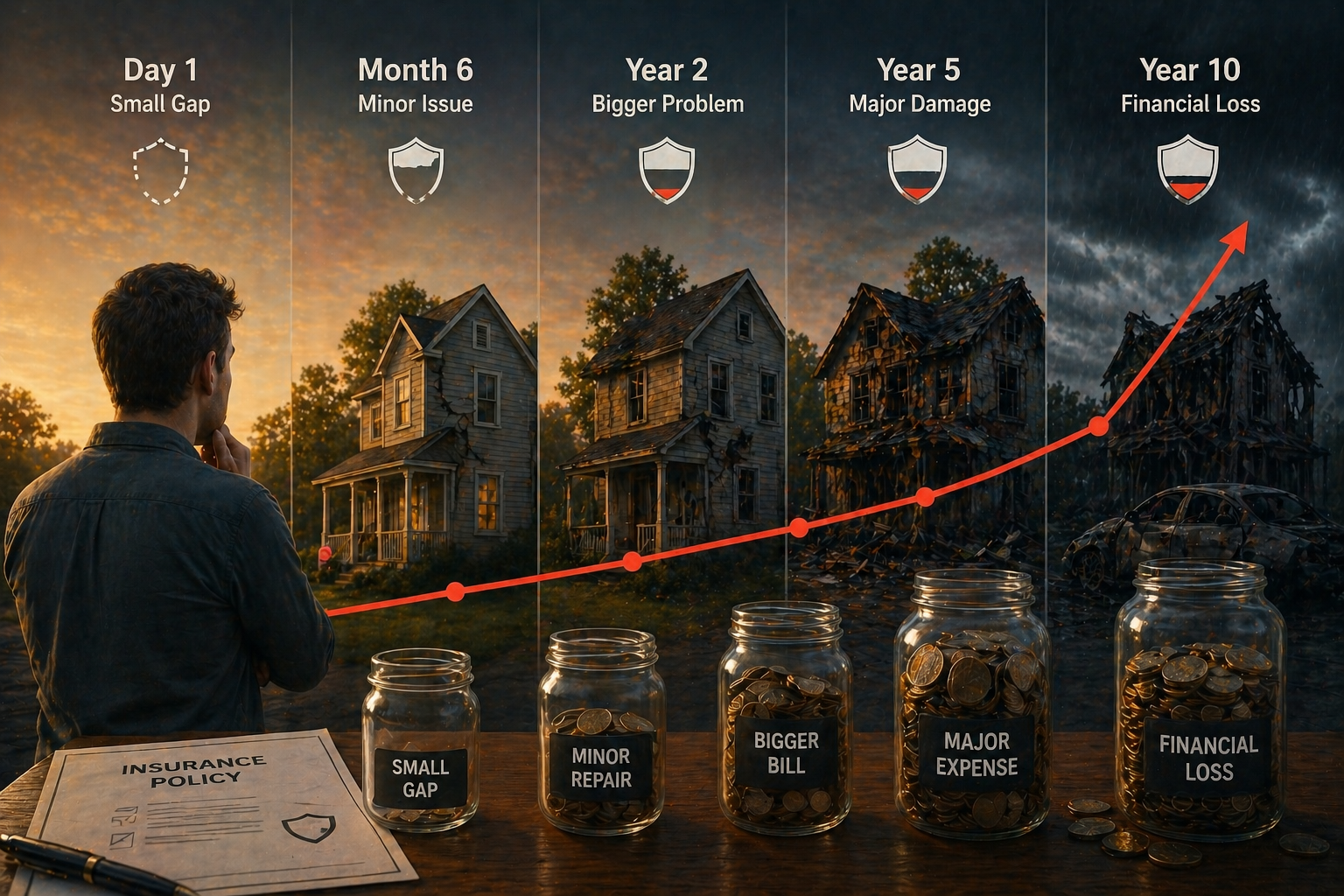
Most of the time, nothing feels missing. Everything seems covered well enough, and that quiet assumption is exactly how how small coverage gaps turn into real losses over time begins to play out without drawing attention to itself.
It Feels Complete — Because Nothing Has Been Tested
At first glance, coverage looks like a finished picture.
You have something in place. It exists, it works in theory, and there’s no immediate reason to question it. That sense of completeness doesn’t come from checking every detail — it comes from the absence of problems.
And that’s where it gets misleading.
Because coverage isn’t really tested when things are calm. It’s only revealed under pressure. Until then, it’s just an idea of protection, not a proven one.
So small gaps stay invisible. Not hidden — just unchallenged.
The Difference Between “Enough” and “Exact”
There’s a subtle line between something being sufficient and something being precise.
Most people operate in the space of “this should be enough.” And most of the time, that works. But “enough” depends heavily on the situation — and situations don’t always match expectations.
What feels like a minor detail can shift the outcome:
- a limit that covers typical scenarios but not unusual ones
- conditions that seem clear until they’re applied in a specific case
- assumptions about what’s included without checking the edges
None of this feels like a mistake while you’re setting things up.
It only starts to matter when reality doesn’t align with what you imagined.
Small Differences Add Up Quietly
The effect isn’t immediate.
That’s part of why it’s so easy to overlook. A small gap doesn’t cause a visible problem on its own. It just sits there, slightly off, waiting for the right conditions to matter.
Over time, though, these small differences begin to accumulate.
Not in a dramatic way — more like a slow drift. One situation passes without issue, another almost exposes a limitation, a third actually does. Each time, the impact feels isolated. Unrelated.
But it’s not.
It’s the same underlying gap, showing up in different forms.

When Reality Moves Faster Than Assumptions
There’s also something else happening in the background.
Life changes. Circumstances shift. What you rely on evolves — sometimes gradually, sometimes quickly. But the original setup doesn’t always keep up with those changes.
And that’s where gaps widen.
What once felt aligned with your situation becomes slightly outdated. Not wrong, just no longer exact. And that difference, even if small, starts to matter more as conditions move further away from the original assumptions.
You don’t feel it happening.
You only notice when something no longer fits the way it used to.
The Moment It Becomes Visible
The realization usually comes all at once.
A situation appears where you expect everything to hold — and it almost does. But not quite. There’s a limit, a condition, a detail that shifts the outcome just enough to make it noticeable.
That’s when the gap becomes real.
Not theoretical anymore. Not something that could happen. Something that has already influenced the result.
And the reaction is often the same: this seemed covered.
It Was Never About One Big Miss
Looking back, it rarely comes down to a single oversight.
It’s a collection of small things that never demanded attention. Details that didn’t stand out. Assumptions that felt reasonable. All of it layered quietly over time.
That’s why how small coverage gaps turn into real losses over time isn’t about obvious mistakes. It’s about accumulation — of tiny mismatches, slight misalignments, and unnoticed differences between expectation and reality.
Nothing dramatic at the start.
Just enough, slowly, to matter later.