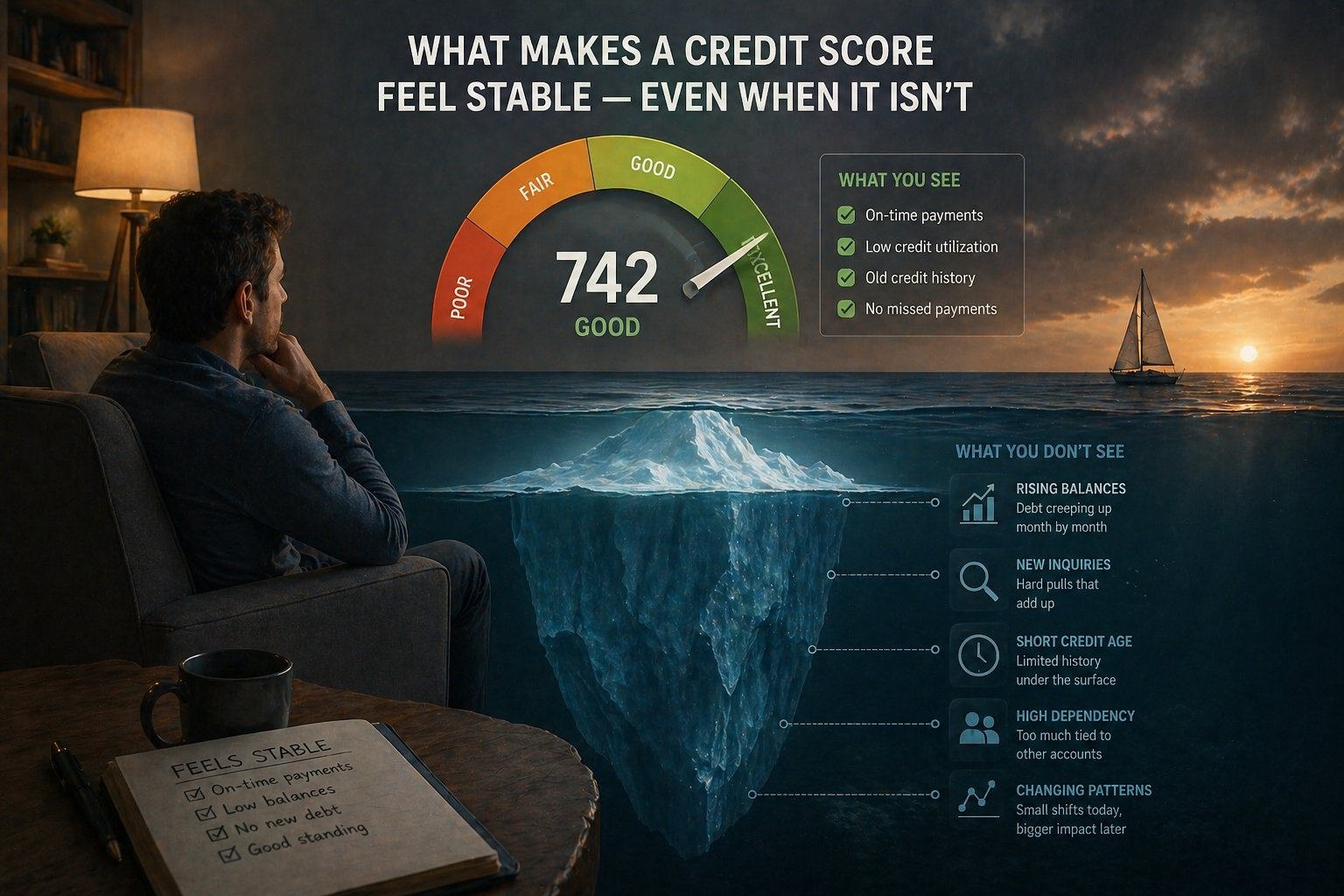
It’s easy to assume everything is under control when nothing seems to change. That quiet confidence is exactly where what makes a credit score feel stable — even when it isn’t starts to take shape, almost without being noticed.
Stability That Comes From Repetition
At first, it doesn’t even feel like a decision.
You check your score once, maybe twice, and it looks consistent. The number doesn’t move much. It holds. That alone creates a sense of reliability — as if stability is something built into the system, not something that needs attention.
But what’s actually happening is simpler.
The same actions are repeating. The same balances, the same timing, the same habits. Nothing disrupts the pattern, so nothing visibly changes. And that repetition starts to feel like proof, even though it’s just continuity.
There’s a difference between something being stable and something simply not being tested.
When Stillness Hides Movement
From the outside, a flat line looks calm.
Internally, though, small shifts can still be happening. Not enough to move the score in a visible way, but enough to change how it reacts later. A slightly higher balance here, a longer repayment cycle there — individually, they don’t stand out.
Together, they create tension beneath the surface.
It’s a bit like something that holds its shape until it doesn’t. You don’t notice the pressure building because nothing has broken yet. So the assumption becomes: if nothing changed, nothing is wrong.
That’s where the illusion forms.
The Moment the System Responds Differently
Everything can feel consistent for months — sometimes longer.
Then one day, something triggers a response. Maybe it’s a new application, maybe a limit adjustment, maybe just a recalculation based on updated data. The point isn’t what caused it, but how it feels.
Unexpected.
Not dramatically worse, just… off. Slightly different from what you thought your position was. And that’s when the realization appears — stability wasn’t as solid as it seemed.
It wasn’t false, exactly. Just incomplete.
Familiar Patterns That Quietly Drift
What makes this tricky is that nothing feels risky while it’s happening.
You’re not doing anything unusual. You’re just repeating what has worked before. But over time, “what worked” can slowly shift into something less reliable, without any clear moment of transition.
Some of the patterns that tend to blend into the background:
- keeping usage at a level that feels normal, but rarely drops
- relying on predictable cycles instead of fully resetting balances
- assuming timing flexibility won’t matter as long as nothing is missed
None of these stand out in isolation.
They only become visible when something depends on them.
Confidence Without Feedback
Part of the problem is how little feedback there is.
You don’t get signals for small changes. There’s no warning for gradual drift. If the number doesn’t move, it feels like confirmation — even if the underlying structure is shifting in ways that aren’t immediately visible.
That lack of feedback creates confidence.
Not because everything is strong, but because nothing is contradicting it.
And over time, that confidence becomes the default way of reading the situation.
When Stability Depends on Context
What feels stable in one moment might not hold in another.
Conditions change — sometimes because of external factors, sometimes because the same behavior is evaluated differently under new circumstances. The score itself doesn’t exist in isolation; it responds to context.
But habits don’t adjust automatically.
They stay the same while the context around them moves. And that gap — between fixed behavior and shifting conditions — is where stability starts to thin out.
You don’t feel it right away.
You feel it when something asks for a clearer answer than your habits can provide.
A Quiet Misunderstanding
In the end, the issue isn’t that the score is misleading.
It’s that the feeling around it is.
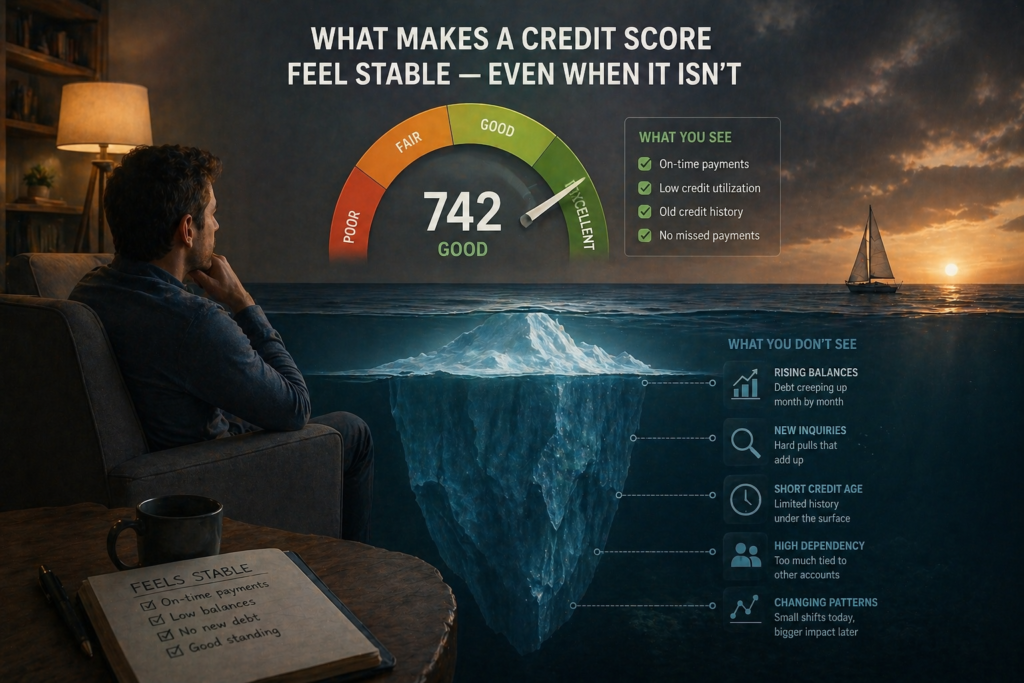
Because what makes a credit score feel stable — even when it isn’t comes down to something subtle: consistency without awareness. Things appear steady because they haven’t been challenged, not because they’re fully secure.
And until that challenge appears, there’s no obvious reason to question it.
Everything looks fine.
Right up to the moment when “fine” has to prove itself.