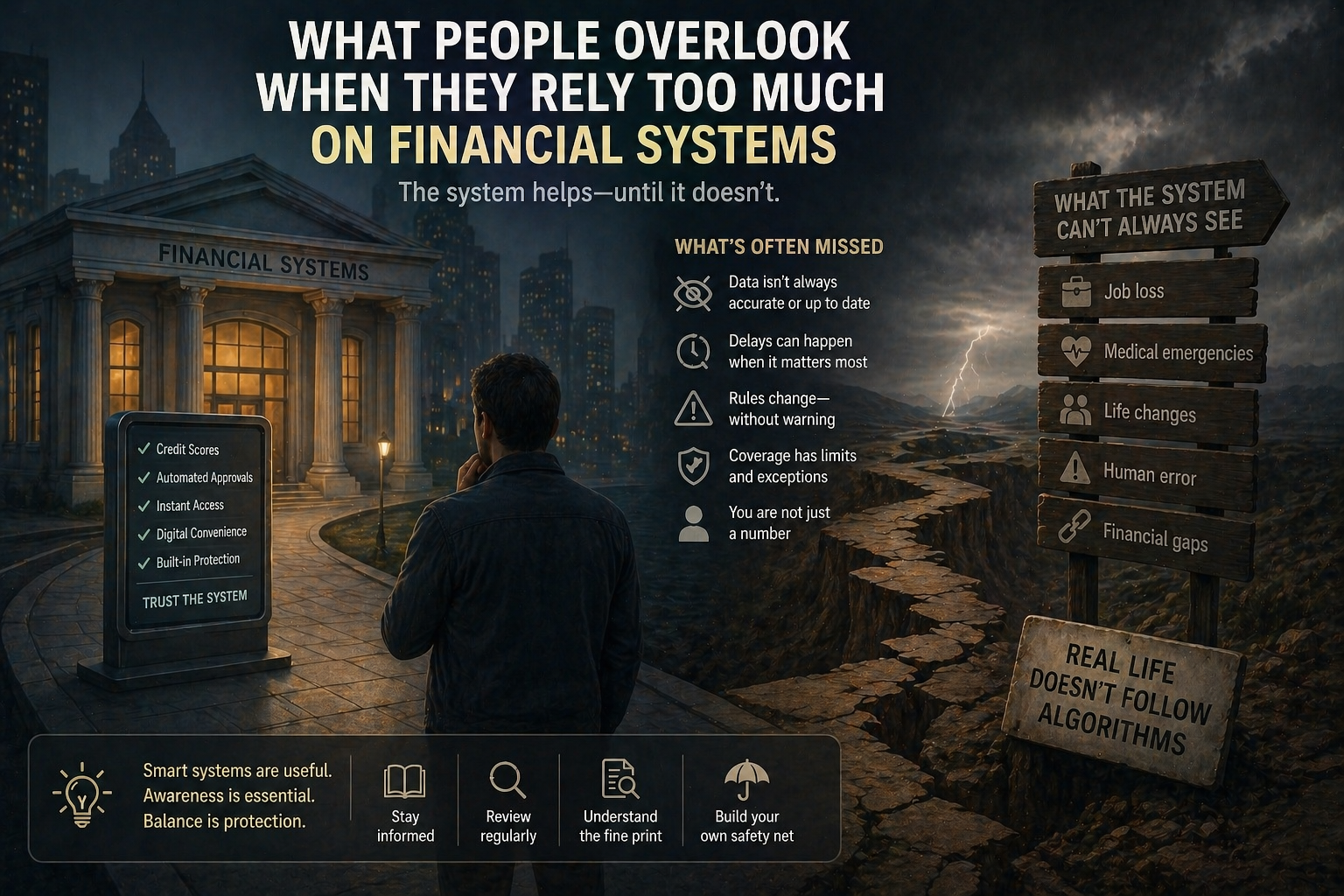
Most of the time, things just work. Payments go through, balances update, approvals come quickly — and somewhere in that привычном процессе скрывается то, what people overlook when they rely too much on financial systems. It doesn’t feel like a problem. It feels like stability.
When Convenience Replaces Awareness
It starts quietly.
You stop thinking about how things actually function. Not because you don’t care, but because there’s no reason to. The system handles it. That’s the whole point.
At first, this feels like progress.
Fewer manual steps, fewer decisions, less friction. You trust the process because it keeps delivering the same result. And over time, that trust turns into something slightly different — a kind of automatic acceptance.
You don’t check as often. You don’t question small inconsistencies. You assume that if something were wrong, it would be obvious.
But systems rarely fail in obvious ways.
The Illusion of Built-In Protection
There’s also this underlying belief that everything important is already accounted for.
Limits exist. Notifications exist. Rules are in place. It feels like there are safeguards built into every layer. And because of that, it becomes easy to assume that risks are already managed somewhere inside the system itself.
That assumption changes behavior.
You rely less on your own judgment. You expect the system to catch issues before they matter. And when something doesn’t trigger a warning, it gets interpreted as “everything is fine.”
A few patterns reinforce this feeling:
- automatic approvals start to feel like validation
- smooth transactions feel like confirmation
- absence of alerts feels like safety
None of these actually guarantee anything. But they feel convincing enough.
When the System Doesn’t See What You Should
There are limits to what any system can track.
It processes data, follows rules, reacts to predefined conditions. But it doesn’t always understand context the way a person does. It doesn’t recognize intent, subtle changes in behavior, or decisions that look normal individually but problematic over time.
That gap matters more than it seems.
Because when you rely heavily on a system, you also start assuming that whatever it doesn’t flag isn’t worth attention. And that’s where blind spots form — not in what is visible, but in what is quietly ignored.
Nothing breaks. It just goes unnoticed.
The Shift From Control to Dependence
At some point, the relationship changes.
You’re no longer just using the system — you’re adapting to it. Decisions begin to align with how the system operates. You trust its structure, its timing, its logic. And without realizing it, you start outsourcing part of your awareness.
It doesn’t feel like giving up control.
It feels like efficiency.
But there’s a difference between using a tool and depending on it to define what matters. When that line blurs, small signals become easier to miss, especially the ones that don’t fit neatly into predefined rules.
And those signals are often the ones that matter most.
When Everything Works — Until It Doesn’t
The problem isn’t that systems fail often.
It’s that when they do, the failure doesn’t always match expectations. You expect a clear alert, a visible issue, something that demands attention. Instead, it can show up as a delay, a mismatch, a decision that suddenly doesn’t make sense anymore.
By then, the situation has already developed.
What felt like a stable environment turns out to depend on assumptions that were never questioned. And because those assumptions were built slowly, they’re harder to identify when things change.
There’s no single moment to point to.
It Was Never About the System Alone
In the end, it’s not really about whether financial systems are reliable.
They usually are — within their limits. The issue appears when those limits are no longer visible to the person using them. When trust replaces attention, and convenience replaces awareness, small gaps begin to matter more.
That’s where what people overlook when they rely too much on financial systems becomes clearer.
Not as a flaw in the system itself, but as a shift in how people interact with it — slowly, quietly, and without any obvious signal that something important is being left out.