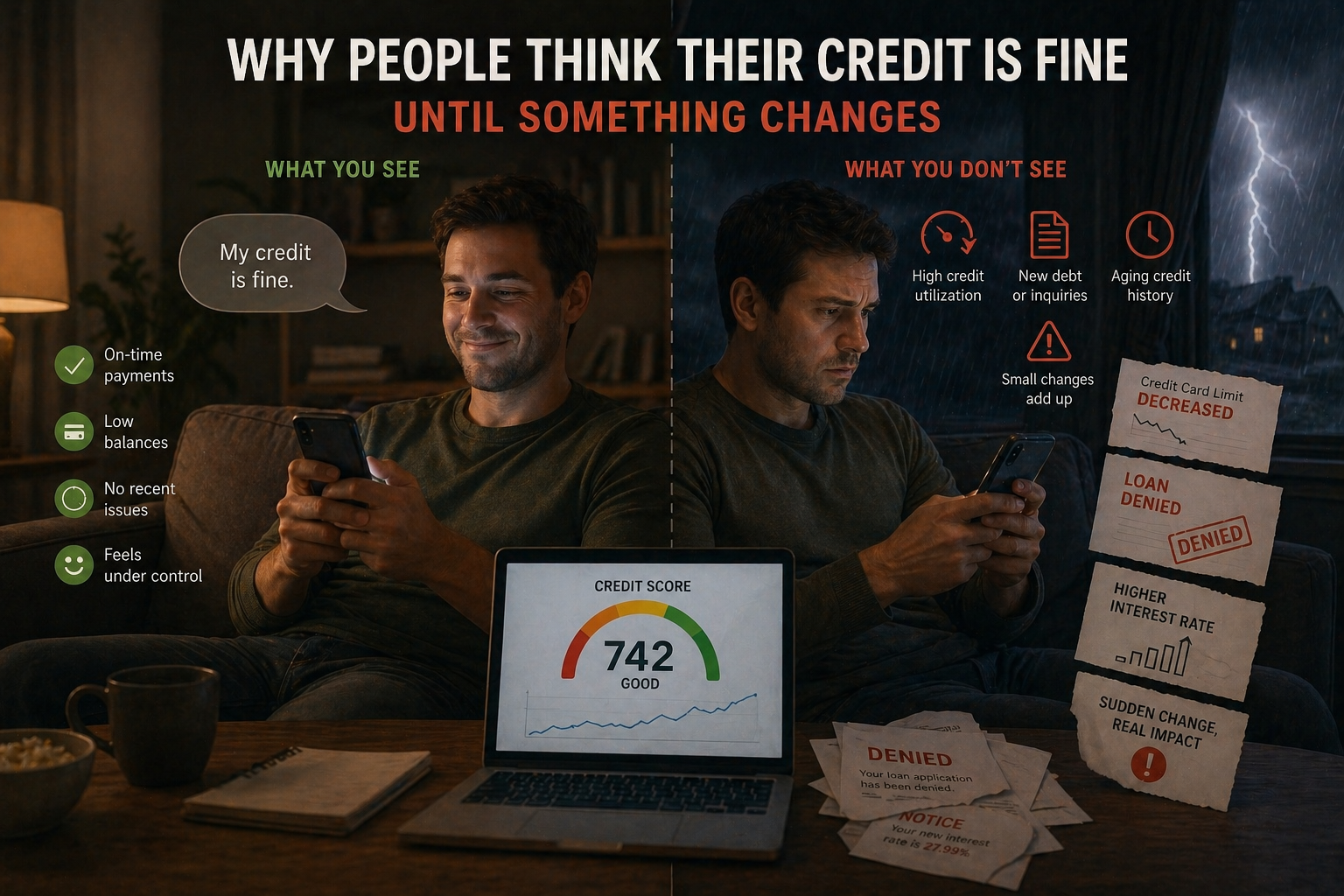
At some point, almost everyone assumes their financial situation is stable enough. Bills are paid, nothing is overdue, and there are no obvious problems — which is exactly why why people think their credit is fine until something changes feels so familiar when it finally happens.
Nothing Feels Urgent — And That’s the Point
There’s a kind of quiet confidence that builds when nothing goes wrong.
You use your card, you repay it. Sometimes fully, sometimes not. You don’t see any immediate consequences, and over time that absence of problems starts to feel like confirmation. Like proof that everything is working as it should.
But the absence of visible issues isn’t the same as stability.
It’s just… silence.
And silence is easy to misread. Especially when there’s no feedback telling you otherwise.
The Moment Something Is Actually Checked
The shift usually doesn’t happen gradually in a way you can feel.
It happens at a specific moment — when something depends on your credit. A loan application, a limit review, a decision that requires an external system to take a closer look.
Until then, nothing has really challenged your assumptions.
And suddenly, the response isn’t what you expected.
Not dramatically bad, not catastrophic — just slightly off. A hesitation. A condition. A different outcome than you had in mind. That’s often the first real signal that something wasn’t as solid as it seemed.
Routine Behavior Doesn’t Feel Like Risk
Daily financial behavior rarely feels meaningful enough to question.
You’re not making extreme choices. You’re not missing payments in a noticeable way. You’re just operating within what feels reasonable. Familiar.
And that’s exactly where the disconnect forms.
Because from the outside, small patterns don’t stay small. They accumulate, align, and start to look like a consistent signal. What feels neutral from your perspective can appear slightly different when viewed as a long sequence.
Some of those patterns are easy to miss:
- relying on available credit more often than planned
- keeping balances at a level that never quite drops
- timing payments in a way that feels acceptable, but not optimal
None of these feel like mistakes.
They feel normal.
The Difference Between Feeling and Measurement
There’s also a gap between how things feel and how they’re evaluated.
Internally, you judge based on intention and control. You know why you made certain choices. You know that nothing was out of hand. That context makes everything seem manageable.
But external systems don’t see context.
They see timing. Frequency. Ratios. Patterns that don’t explain themselves — they just exist. And those patterns are interpreted without the story behind them.
That’s where the mismatch appears.
Not because something is wrong in an obvious sense, but because it’s been measured differently than expected.
Stability Isn’t Static
Another thing that slips by unnoticed is that stability isn’t fixed.
What felt stable a year ago might not carry the same weight now. Conditions change — sometimes outside your control, sometimes gradually. And behaviors that once seemed harmless can take on a different meaning in a new context.
But habits don’t always adapt that quickly.
They stay consistent, even when the environment around them shifts. And that consistency, while comfortable, can slowly drift away from what’s actually needed.
You Don’t Notice Until You Need It
The reason this catches people off guard is simple.
There’s no reason to question anything — until there is.
Credit doesn’t demand attention on a daily basis. It doesn’t interrupt. It doesn’t signal small changes in real time. It just reflects them, quietly, in the background.
So everything feels fine.
Until a moment arrives where it has to be evaluated. And that’s when why people think their credit is fine until something changes becomes clear — not because something suddenly broke, but because the full picture was never visible in the first place.
It was forming all along. Just not in a way that demanded to be noticed.