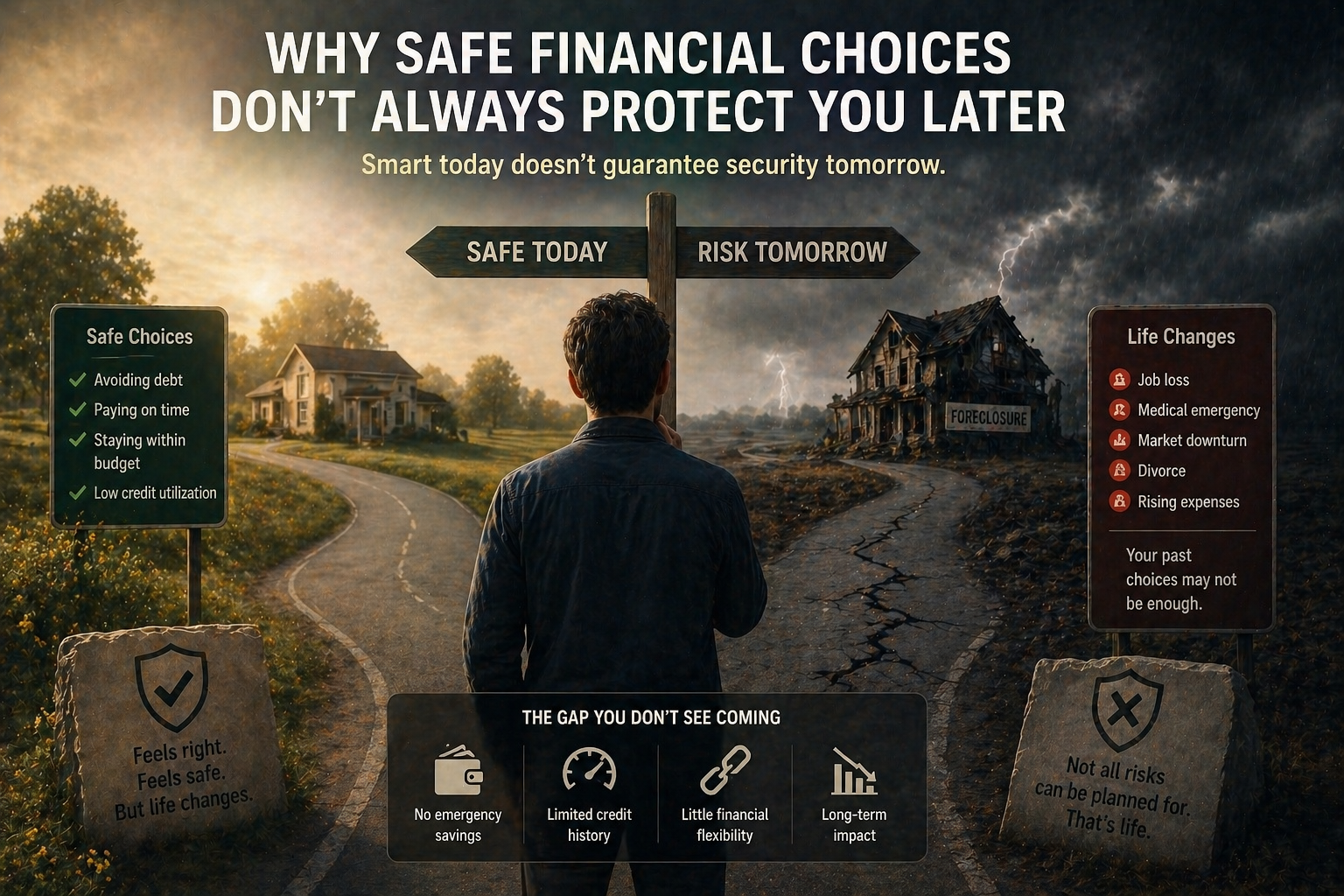
It feels logical at the time. You choose stability, avoid unnecessary risk, keep things predictable — and still, why safe financial choices don’t always protect you later becomes clearer only after something shifts. Not suddenly. More like a quiet realization that what once felt secure no longer works the same way.
Safety Depends on the Moment, Not Forever
A decision can be safe — but only in the context where it was made.
That part often gets overlooked. You make a careful choice based on current conditions: income is steady, expenses are known, risks seem limited. Everything aligns. The decision fits.
And then time passes.
Conditions change, but the decision stays in place. What was once balanced starts to drift. Not because it was wrong, but because it was tied to a moment that no longer exists.
That’s the uncomfortable part. Safety doesn’t travel well across time.
The Trade-Off You Don’t Feel Right Away
There’s always a trade, even in cautious decisions.
You reduce uncertainty, but you also limit flexibility. You avoid exposure, but you may also reduce growth or adaptability. None of this feels like a loss in the beginning because the benefits are immediate — less stress, fewer variables, more control.
But over time, those hidden costs begin to show.
They don’t appear as mistakes. They show up as constraints. As fewer options. As decisions that feel harder to adjust because everything is already structured around a certain level of safety.
It’s subtle. And easy to ignore.
When Stability Becomes a Fixed Position
There’s a point where staying safe stops being a choice and becomes a habit.
You keep doing what worked before. You trust the same patterns. You rely on decisions that once proved reliable. And because nothing breaks, there’s no clear reason to reconsider.
But stability can turn into rigidity.
What once protected you can start limiting how you respond to change. The environment moves, but your position doesn’t adjust as easily anymore. And the gap between those two grows slowly, without pressure to act.
A few signs tend to appear along the way:
- decisions feel harder to change than before
- alternatives seem riskier than they used to
- familiar options keep being chosen without much thought
None of these look like problems on their own.
The Risk of Avoiding Risk Entirely
It sounds paradoxical, but avoiding risk completely creates its own form of exposure.
When everything is optimized for safety, there’s less room for adaptation. You’re protected against certain outcomes, but more vulnerable to others — especially the ones that require movement, flexibility, or change.
And those are harder to anticipate.
Because nothing feels wrong while you’re avoiding risk. In fact, things feel under control. But control in a stable environment doesn’t always translate to control in a changing one.
That difference only becomes visible later.
The Moment When It Feels Too Late to Adjust
One of the more difficult aspects is timing.
You don’t usually notice the limitation while you still have full freedom to adjust. You notice it when adjustment becomes harder — when the cost of change is higher, or when the structure you built resists it.
By then, the decision feels less like a choice and more like a position you’re already in.
That’s when the original “safe” choice starts to look different. Not wrong, just incomplete. It solved one problem while quietly creating another.
It Was Safe — Just Not in Every Direction
Looking back, most safe financial decisions make sense.
They were careful. Reasoned. Appropriate for the situation at the time. The issue isn’t that they were bad decisions — it’s that they were only optimized for one version of the future.
And reality doesn’t stay that consistent.
That’s why why safe financial choices don’t always protect you later isn’t about rejecting caution. It’s about recognizing that safety has direction. It protects you from certain risks while leaving others untouched.
You don’t notice that imbalance when everything is stable.
You notice it when something changes — and the protection you relied on doesn’t extend as far as you expected.